Monday

A Higher Stage for Minimum Wage

Today, the Seattle City Council approved an increase of the Seattle's minimum wage up to $15.   Seattle Mayor Ed Murray is expected to sign the ordinance on Tuesday.

Currently, the federal minimum wage is set at $7.25 an hour.  The minimum wage in the state of Washington is $9.32, which is already the highest state-level minimum wage in the country.  The increase to $15 will only be effective within the city boundaries of Seattle, and will be effective for large businesses in 2017 and for every business in 2021.

Supporters of the increase in minimum wage hope that increasing the minimum wage will lift hundreds of thousands of people out of poverty, reduce the wealth gap in America, and increase spending, among other economic benefits. I believe that raising the minimum wage is a good first step to fixing many of these problems, but I believe that more can be done as well to help bridge the gap between the rich and the poor as well as reduce poverty in our country. With Seattle being the first place to drastically hike up the minimum wage, only time will tell how it effects the economy of Seattle.

Local businesses have numerous complaints about the increase in wages. They are saying that the increase will cause them to cut jobs and halt future expansion plans. If cutting jobs and slowing expansion end up being results of the increase in minimum wage, then the plan may end up hurting more than it helps. Raising the minimum wage by around 60% could be especially problematic for small business trying to get their feet under them, which could also hinder the economy if small businesses begin failing. Luckily for these companies, the large companies have over two years, and the small businesses have over six years to prepare themselves for the new minimum wage hike.

What do you think about this increase in minimum wage in Seattle?  Do you think this should become a nationwide change? What do you think are the pros and cons of increasing the minimum wage?

Wednesday

New College Rankings


Around the halls of New Trier High School, hardly a day goes by where people aren't talking about colleges and comparing the hundreds of colleges that kids are applying to.  It is natural for us to try to declare that one college is better than another in every way, because it is easier to then create rankings.  However, it's not always easy to decide which college is "better" than any other college.  The US News and World Report, Forbes, and many other publications have attempted to do this for years, but the different methodologies of each ranking make each one drastically different.  How do you decide whether Yale is "better" than Harvard?  No one can really definitively know, but President Obama is determined to do so.


The Obama Administration has announced their plans to introduce a government college ratings system.  Reasons for this change are that they want to help students weigh the pros and cons of certain schools as well as to prove that the $150 billion dollars the government gives to colleges and universities each year is worth it.

The new government-run rating system would factor in things like how many of their students graduate, how much debt their students accumulate, and how much money their students earn after college.

I think that these changes can really help our country if done the right way.  I think it could give students better advice on which college will be most worth their money, and I think it could filter out schools that are expensive and don't have graduates that are making enough money to pay for their education because the colleges themselves are bad.

What do you think about the government getting involved in college rankings?

Sunday

Betrayed by the Game

For my junior theme paper I read The Last Shot by Darcy Frey.  It is an account of the year the Frey spent with the Abraham Lincoln High School basketball team in 1991.  He followed the lives of Corey Johnson, Tchaka Shipp, and Darryle Flicking.  All three of them were stars on the team and were being recruiting by Division 1 schools to play basketball.  When the book ends, Tchaka is going to Seton Hall on a full ride, Corey is going to junior college in Texas, and Darryle is going to junior college around Los Angeles.  However, the obstacles put in front of them by life in Coney Island kept all of them from achieving their dreams.

Of the three, Tchaka had the most promising future because by the end of high school he had secured a full scholarship to Seton Hall, a Division 1 school.  Throughout Tchaka's recruitment, the coaches at Seton Hall would repeatedly tell him that he'd contend for a starting spot right away, that they thought he could be star, and that they thought he could have a chance at the NBA if he went to Seton Hall.  However, soon after arriving on campus Tchaka learned that these were all lies, and that he had been recruited as a bench player the whole time.  After two fruitless years at Seton Hall he transferred to UC Irvine in hope of more playing time.  One night while driving back to campus after practice, Tchaka fell asleep at the wheel and got in a bad car accident, leaving him with life-threatening injuries to his skull, lungs, legs, and hands.  He was never able to play basketball to his potential again because of the injuries.  After the accident, transferring to CW Post, and a failed tryout in the semi-pro leagues, Tchaka gave up the game of basketball and has been living paycheck to paycheck doing manual labor ever since.

After spending some time in the JuCo leagues in Texas, Corey Johnson lost hope in ever being recruited to a Division 1 team, lost motivation and dropped out of school.  He then continued to pursue his dream of becoming a poet by writing his first set of writings to be published.  He has continued to struggle after high school, living paycheck to paycheck just as Tchaka has.

Lastly, there was Darryle Flicking.  After becoming one of the best JuCo players around, Flicking was recruited by many Division 1 coaches, but decided to go to Division 2 UC-Riverside because he felt he could better focus on earning his degree there.  He did eventually graduate in 1996 with a degree in sociology.  But his mental and emotional troubles from his childhood stayed with him.  He was arrested twice for abusing his wife while in college, and later became homeless.  Then in 1999 he was walking along railroad tracks and was fatally struck from behind by an Amtrak train, which friends of his believe to be a suicide, which he almost attempted during his time at Lincoln High.

For all of these players, basketball was the promised road out of their struggles.  They chose basketball in order to avoid the troubles of getting involved in drug dealing in the streets of Coney Island, but in the end, how much better off are they?  Unfortunately, the sometimes cruel world of Division 1 basketball holds more stories like these than the publicized success stories of a lucky few who make it.


Monday

World Hoops

Over the past couple weeks, I have been reading The Last Shot by Darcy Frey, which tells the story of college basketball recruitment of a few high school basketball players from Coney Island, New York.  Since beginning the book, I have been looking more closely at topics related to the book.

This past Saturday, Nike hosted the Nike Hoop Summit, which was a showcase game played between Team USA and the World Team.  Team USA was comprised of the best seniors in high school from the United States, and the World Team had the best seniors in high school from the rest of the world.  It was a fantastic event which showcased the best talent form across the world, yet I couldn't help but see all the parallels to Darcy Frey's book and the rest of my basketball knowledge.

In the book, it is mentioned that shoe companies try to build relationships with young players as early as possible.  The Nike Hoop Summit is the perfect example of this.  Nike pays for the whole thing, gives them free uniforms, shoes, and other gear.  Nike feels that their payoff will be that when one or two of these players become the next big thing in the NBA, they will have built enough good credit with the player and a strong enough relationship to convince him to sign his endorsement deal with Nike instead of Adidas, Under Armour, or countless other brands.

In addition, I think this is too big of stage to be putting high school kids on.  Before these kids have even stepped foot on a college campus, they are being compared to the best players in the entire world on national television.  While listening to the broadcast, I heard them mention that there were many NBA scouts in attendance.  While this does make sense considering most of these players won't go to more than a year of college so they could be in the NBA pretty soon, I think people have to realize how many of these kids probably won't end up being NBA prospects a year or two from now.

Thursday

Favoring the Underdog

It always happens.  Every year.  In the NCAA Tournament, there is always at least one school we've never heard of that shocks the world by beating a perennial powerhouse.  Dayton, Florida Gulf Coast, Lehigh, Norfolk State, Wichita State, and VCU are recent cinderella stories that come to mind.  And year in and year, out everyone is rooting for these schools that they couldn't even point out on a map.

I find it fascinating that there really seems to be no other feelings towards these teams besides people rooting for them.  I feel like there's a counter-argument to almost everything else, yet there seems to be unanimous support for these underdogs.  Maybe someone could say that they'd rather have the better team advance, or that a program with an established culture of winning deserves to go farther in the tournament than an irrelevant team that got lucky one night.  But I never hear these arguments, which begs the question:  Why are we so obsessed with the underdog?

I believe that it's simply the American way to cheer for the underdog.  It begins with our roots as a country in which we started as colonies ruled by Great Britain, eventually fighting our way against the world's most powerful nation and gaining our independence.  We're the country that people from across the world immigrate to in search of a new life and a place in which one could find success if they are willing to work.

Why do you think we as a society love the underdog?  Do you love the underdog?

Follow Up to "3D Printing: More Than a Toy"

Back in January, I had posted on the new and innovative technology of 3D printing.  I had discussed  how 3D printing was becoming much more than a novelty, and had the chance to truly change the landscape of many industries.  Since then, I had not come across any new advancements or news in the 3D printing world, until I came across this incredible article today.

Mick Ebeling tells the story of how he heard of a Sudanese boy named Daniel had his arms detached from his body during the Sudanese government's bombing raids.  That night, he couldn't go to sleep without trying to help out.  He knew he wouldn't be able to help all of the kids who had limbs blown off in the explosions, but he knew he had to try to help Daniel.

Ebeling surrounded himself with the smartest people he could, and they came up with the idea of bringing a 3D printer to Sudan to print the prosthetic arms there, while teaching people in Sudan how to use the printer so they could continue to help more people.

In case you aren't familiar with 3D printers, they mostly operate just as regular printers do.  They are connected to computers, and they print files from the computer.  But, 3D printers are able to print three-dimensional objects right in front of you.  So in this case, the proper materials had to be loaded into the printer, and computer-designed 3D parts of the prosthetic arms were printed on the spot.

In the end, the prosthetic arm worked for Daniel, and will end up helping countless other children who have unfortunately lost their limbs.  It is incredible how the 3D printer is being utilized now even though it has not existed for very long.  Stories like this can only leave us wondering what 3D printers will be doing next.

What other uses do you think 3D printers could have?  Do you see the use of 3D printers growing even more?

Monday

Middlebury vs Middlebury

Upon checking into a quaint inn in Middlebury, Vermont, the man behind the front desk looked me up and down and immediately said, "Here's a pamphlet on the College, enjoy your stay" in a cold, rehearsed voice.  I hadn't mentioned a thing to him about the college.  It was as if he was disdainful about how the only reason he thought I would ever consider setting foot in his small town would be to visit the local college; which was actually exactly why I was there.

Later that night at the conclusion of dinner at the inn, the extremely welcoming and kind waitress told us that she hoped we would enjoy seeing Middlebury College tomorrow in almost an identical tone as the man behind the front desk.  Again, we made no mention of Middlebury to her whatsoever.  At this point I knew there had to be something more between the people of Middlebury and the students at Middlebury College.

As soon as a began to look into the topic, I came across a documentary made by local students at the high school about this exact relationship.  The tone of the video is set immediately by a high schooler saying that if he was in a car driving through the campus, he would hit the next Middlebury College student that crossed the street without looking.

One of the issues between the students of Middlebury College and the residents of Middlebury, VT is that there is an enormous financial gap between them.  In terms of the college itself and the town itself, a few examples were given in the video of major town projects having to be majorly funded by the college because the college has more many the town itself.  This is not different on the person to person level either.  In Middlebury, the median household income is $48,487, while the total annual cost for one student to go to Middlebury College is just under $60,000.  This immense financial gap seems to create a lot of tension and resentment from the less wealthy people of Middlebury to the more wealthy students at the college.  In my brief experience, the students at the college have almost the opposite feelings about the residents of the town.  One student described the people of the town as "sweethearts" and said that "The people here make it the most wholesome and friendly place I've ever been."

I think this relationship is particularly interesting because I see it as a sort of microcosm of the larger financial gap throughout the United States.  The large gap between the middle class and the "1%" is a continuous struggle in this country that has not seen any progress in being resolved.

I believe that the best solution in both the smaller case of Middlebury as well as the larger case of the United States is that the people need to settle there differences and work to get along.  There isn't a whole lot either side can do to help decrease the financial gap, but I don't think that's what necessarily needs to happen anyways.  People should be able to get along despite financial or any other differences.  The town of Middlebury offers as much to the college in certain ways as the college does to the town in other ways.  Even though the issue of financial differences isn't going away any time soon, hopefully the attitudes of the town of Middlebury and Middlebury College as well as the attitudes of the middle class and "1%" does change soon.

Do you think the feelings of resentment are justified?  What would you do to solve the problem?


Sunday

Abusive Coaching

Startling news came out of Boston University's athletic department this weekend.  According to a recent report, the head women's basketball coach at Boston University, Kelly Greenberg, is under investigation for bullying her players.

Greenberg reportedly bullied four players to the point that they all abruptly quit the team this year. Greenberg reportedly called one player "selfish" for not playing through a concussion, and causing another player to be checked into a hospital for being suicidal.

This scenario sounds all too similar to what happened with the former Rutgers head coach Mike Rice last season.  Mike Rice was fired shortly after hours of practice videos were released showing Rice throwing balls at players, shoving them, and using very offensive language while yelling at his players.

I think these occurences are becoming more common because of the increased power that universities give their athletica departments, and because of how much control college sports teams have over their players.  For these girls, quitting the team results in a loss of their scholarship. So for the girls who have not left the school, they will now have to pay around $60,000 a year, which will be extremely difficult because they were most likely not accounting for paying for school in hteir finances because they were on scholarship.  This ends up making the student-athletes prafctically tied-down to playing for these teams, no matter how bad the sitaution is, because they need the scholarship money to pay for school.

Something needs to change in the world of college athletics.  Even though Mike Rice was fired, and it would appear that Kelly Greenberg will be fired, those players can't get the time back that they lost while being miserable attending school.  There needs to be some sort of student-athlete union that could investigate these issues and gain retributions for these players, such as possibly having Boston University keep the girls on scholarship if they remain at the school.  Sports should be an enriching part of a student's time at school, not something that makes them want to leave the school.

What do you think of these reoccurring instances?  How do you think we can change this culture in college sports?


Monday

I Pledge Allegiance to the Brand...

Apple electronics, Nike shoes; well, Nike for just about anything sports-related, Crest toothpaste, North Face winter clothing, and the list goes on and on.  These are the brands I repeatedly buy from over and over again.  But why?  I couldn't use any facts or statistics that make Nike shoes better than Adidas shoes, yet whenever I'm buying new shoes I wouldn't even consider leaving Nike.com.  Or when I'm at Walgreens I always grab the Crest toothpaste without hesitation.  Does it more effectively clean my teeth than what Colgate makes? I have no idea, I've just always used Crest.  Is there any significant difference between the toothpastes? Probably not, yet I'm always sure I'm grabbing the tube of Crest instead of all the others.

I think there are many things that factor into brand loyalty, with one reason being easiness.  There's no denying that buying products is much easier if you can narrow everything down to only looking at the products your specific brand produces, which ties into the apparent increase of a lazy culture in America. 

I believe that brands try to gain loyalty by creating a battle with their rival.  Nothing conjures up more polarized and strong opinions than a declared war.  I'm sure everyone remembers the old Mac vs PC ads, and it's hard to think of a more polarized brand battle than the hardcore Mac vs PC people.  I think the idea that someone gets to join a group of people while facing an opposing group makes the brand loyalty stronger for them because of the classic mob mentality.

What are some of your brand loyalties?  How did you develop them?  How do you think people develop their brand loyalties?  How do you think companies encourage brand loyalty?


"How to Completely Botch the Olympics" by Russia

I had heard maybe a month or two ago that Sochi was behind in schedule in the development of a lot of the hotels for the Olympics, but I didn't really think that the news was that serious.  I mean, they're clearly going to have to finish the buildings by the time the Games start, right?  Well, to my surprise this weekend I found out that I was very wrong.  I came across an article showing the horrors of the Sochi hotels via pictures posted on Twitter.

I couldn't believe what I was looking at.  It was as if the people in Sochi found out they were hosting the Olympics two weeks ago.  There were completely trashed rooms, unfinished rooms, piping hanging form the ceiling in hallways, missing walls, and many other atrocities.  Also, I couldn't believe how Russia could allow this happen.  The geographically largest country in the world and one of the proudest countries allowed themselves to screw up the most important event on the largest stage there is.  I would've thought that they would've taken the opportunity of hosting the Olympics as a way to flaunt how great Russia is, but they unfortunately fell way short of that.  This is not the only way Russia has embarrassed itself so far either.

What do you think of how unprepared Sochi was for the Olympics?  Did you ever expect something like this to come from a global power such as Russia?

Heroin Taking Heroes

The world was shocked and saddened yesterday to hear the news of the death of renowned actor Philip Seymour Hoffman.  He was reportedly found dead in his apartment with a needle in his arm, and many bags of heroin scattered throughout the apartment, indicating a drug overdose, even though an offical autopsy has not been completed.

Unfortunately, these instances of celebrity drug overdose are not uncommon, and seem to be increasing as of late.  This past July, Cory Monteith, an actor on the popular show "Glee", was found dead in a hotel room in Vancouver due to a drug and alcohol overdose.

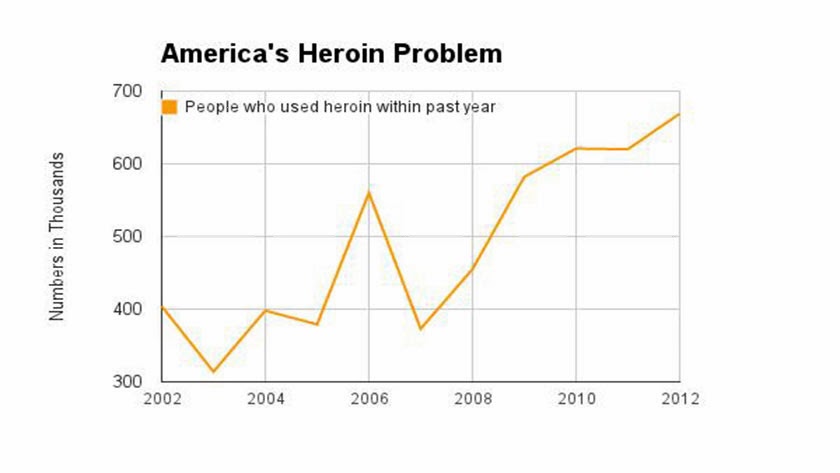
These two incidents are just a microcosm of a growing problem of the increasing heroin use across the country.  According to The National Survey on Drug Use and Health, the number of Americans who had used heroin in the past year had risen from 373,000 in 2007 to 669,000 in 2012.  That means that in those five years, heroin use in the U.S. doubled.


The increase in numbers seems to be related to an increase of how easy it is to obtain the substance, the increased purity of heroin, the lowered price of it, and influence of a Mexican drug cartel pushing heroin into the United States.  Whatever the true causes are, I believe that this is a serious problem and that the United States needs to take a serious approach at trying to help reduce these numbers.  

What do you think are the reasons for these increases?  What measures would you take to solve the problem?


Thursday

3D Printing: More Than a Toy

While checking on the news for one of the stocks I hold in my Consumer Seminar's stock market game, I came across breaking news that 3D Systems (the company I hold imaginary stock in), is partnering with Hershey's to make a chocolate printer.  Yes, you read that correctly.  A machine that will print chocolate.

For those of you that don't know what 3D printers are, here is the basic idea.  They are the latest in printer technology, and they are the same as regular printers in that they're hooked up to a computer.  But instead of printing paper, these printers print three-dimensional objects.  So theoretically, you could design a toy on your computer and have it printed right in front of you.

This new technology also has major commercial applications.  Imagine buying those pair shoes you want so bad online, and instead of having to wait for it to be shipped to you, it is printed right in front of your eyes.  This completely eliminates the factory and any shipping that takes place.  If this technology theoretically became as prevalent as regular printers, the world's economy would see an incredibly drastic shift with the elimination of shipping companies and assembly factories.  Obviously this scenario is extreme, unlikely, and very far away if it would happen, but it illustrates just how big of an impact these printers could have.

Do you think these printers will become as popular as 3D printers?  What problems do you see in the future for 3D printers?  Would you buy a 3D Printer?

No More "FaceTime"

Over the holiday break, I was able to spend a lot more time than usual with my family, especially because I have an older brother in college.  While the increased family time was great, I noticed how much my siblings and cousins were on phones or iPads almost all day, even using phones at dinner.  I couldn't help but think of how relevant this was in the grand scheme of things, so I decided to do some research to find out how experts thought this behavior was affecting our society.

In this article, many great points are brought up about how cell phones are killing social interaction; even in 2007.  And I think it's safe to say that cell phone and other mobile device use has skyrocketed since 2007.  Think about how frequently you pull out your phone whenever there's a free moment in your day, or how you're always buried in your phone whenever you're sitting somewhere alone.  Cell phones kill any chance of you actually experiencing something useful during this time.

For instance, last week I was having a conversation with a teammate of mine on the basketball team I said to him, "Could you imagine how much more productive people would be with schoolwork if everyone had your phone instead of an iPhone?"  He responded quickly by saying, "Or just more productive in life in general and basic human interaction."  What he said could not have been more true, and I had never really thought about it that much until then.  Whenever I am with friends, or really anyone for that matter, a few minutes never go by without someone checking their phone.  For whatever reason, people seem to feel the need to always be connected to something or someone bigger; such as texting people who they're not with, or checking out what's going on in social media at the moment.

Nowadays, no one seems to ever be content just sitting alone thinking, or sitting alone in public.  While alone, people should at least spend a little time in self-thought and reflect on their day.  People are so worried about what's happening on Facebook or Instagram, that they never really get to think about what's going on in their own lives.  Also, I feel like meeting new people for recreation is an art this is being diminished by cell phones and mobile devices.  While I am also guilty of having my head buried in my cell phone at most times when I'm in public alone, it is almost always well worth the effort of striking up a conversation with someone you don't know.

While I don't think this trend will slow down at all, I think it is important for people to think about how much they are on their phones throughout the day, and how much they could be missing.  Because there's an entire world outside of that three inch screen in front of your face; if you're willing to just leave it in your pocket.

What do you think of the increased use of mobile devices?  Do you notice these same trends in today's society?  Are you guilty of always being on a cell phone?


Sunday

Have We Actually Moved On From Black and White TV?

After hearing the topic discussed briefly during an American Studies class, I began to pay attention more to how race is displayed in modern television, and specifically how segregated television is.  After watching any major TV network for 30 minutes, it becomes increasingly clear that our televisions are really still black and white.

While first examining commercials, I naturally wanted to look at the the most significant and most viewed commercials in America.  So what better commercials to analyze than the those that played during the most recent Super Bowl, the most watched event in the world.  I conveniently found all of these commercials on one website.  The first video I watched was one that the NFL itself aired.  It consisted of NFL players appearing in giant boxes to thank NFL fans for being there for them.  Throughout the entire commercial, not one African-American fan was "thanked", and the only African-Americans in the commercial were a few of the NFL players.  

After watching more commercials I came across another interesting example, but this one did have an African-American person in it - but just one.  This Budweiser commercial was set in some upscale restaurant or club, and shows several close-ups of people in expensive clothes having a good time.  The end of the commercial cuts to an aerial view of a table with about thirty people.  Only then do I see the one and only African-American in the whole commercial.  And to me, it almost seems like someone in at Budweiser made the director put in one African-American man in order to avoid accusations of excluding African-Americans.

Then, I began to think about television shows today.  It took me about 15 minutes to finally think of even one show in which the main character or characters are African-American.  I thought of "The Fresh Prince of Bel-Air", and that show isn't even on anymore.  And after more thought I began to wonder if in this instance the underlying joke of the whole show was that there could even be an African-American family with that much money. The creator of the show is Andy Borowitz, a white man, which made my theory even more plausible. Also, the main character in the show is Will, who has not outgrown his roots in urban Philadelphia.  This ostracizes him from the rest of his family in many ways because he is the only member of the family who acts like the stereotypical African-American teenager. 

I do not understand the lack of other races being shown on television when we call this country a "cultural melting pot".  Why do you think TV is so predominantly white?  Do you think it matters that there is not an equal representation of races on TV?


What Happened to Real Music?


What does the fox say?  We've heard the answer over a hundred time in Ylvis' new video that has gone viral over the past month.  We've seen this pattern occur before with Psy's "Gangnam Style" video.  A no-name artist makes a catchy song with unintelligent lyrics, and after a few days on YouTube, this former irrelevant figure in music becomes the latest world celebrity, making millions of dollars.  All because of one song.

Whatever happened to making quality music?  Thousands of artists spend years perfecting their crafts, attending music schools, working under successful musicians, and spend years playing small gigs in bars; and the vast majority of these people never end up making it big.  But now it only takes one person with a computer that can computerize their vocals for their comical lyrics to make millions of dollars and achieve instant fame.  I think this is a very upsetting trend that is becoming more and more common in today's world.

What do you think of this new trend in music?  Do you think it's here to stay?


Vandalism or Virtuosity?

One of Banksy's many works of graffiti that appeared this month in NYC
Every day this month, New York City has been greeted by a new work of art courtesy of world renowned street artist Banksy.  Each day, the people of the city have woken up to find a new masterpiece by Banksy, in which he has used every corner of New York City as his canvas.  Thousands of New Yorkers have been flocking to see his latest work and to take pictures with his sometimes humorous work.  But, not everyone in New York is thrilled to have Banksy taking a "residency" in their city.

New York City mayor Michael Bloomberg said in a press conference that "...graffiti does ruin people’s property and it’s a sign of decay and loss of control...
I just think there are some places for art and there are some places [not for] art. And you running up to somebody’s property or public property and defacing it is not my definition of art."

First of all, I do understand that rules are rules, and by law, graffiti is illegal, and I understand that.  But, I really think that in this instance, New York should tolerate Banksy's work.  They should be grateful and honored that the most famous street artist in history has chosen their city as his canvas for the month.  Also, I do not think that he is "defacing" the city of New York because frankly, his work is really good.  It's definitely an improvement to any of the dirty, rusted urban structures he utilizes as a canvas.  New York is one of the biggest cities in the world, and is known for its incredible art scene, so it makes even less sense that there would be criticism or opposition to having one of the best artists in the world giving away free work to the city.

Do you think New York and other cities should be more tolerant of graffiti?  Do you think graffiti laws should be changed?


Tuesday

There's a Storm A Brewin'

Nevin Shapiro with a former Miami football player
After three long years of intense investigation, the NCAA has finally reached an agreement on how to punish the University of Miami for committing, "...a wide array of the most serious violations in the NCAA Division 1 Manual", according to Ivan Maisel of ESPN's recent report. 

These violations include:
  • Bylaw 11, involving impermissible compensation to coaches;
  • Bylaw 12, involving amateurism of athletes;
  • Bylaw 13, involving improper recruiting activity; and
  • Bylaw 16, involving extra benefits to athletes

In addition, former Miami athletics booster Nevin Shapiro, pictured above, was accused of giving a large portion of these benefits to players in the form of nights out to clubs, cash, and other expensive gifts.  At the time the initial report came out in 2011, NCAA president Mark Emmert said, "
If they're found to be true, it appears we've had a third-party individual have a really pernicious impact on a huge cross-section of student-athletes. The breadth of that would be pretty shocking."

Yet when the NCAA finally issued its punishments upon the University of Miami, the country was shocked at how little Miami will actually be affected for committing some of the biggest violations in the history of college athletics.  Their punishment is the reduction of nine football scholarships and three basketball scholarships over the next three years.  That's it. So for years of repetitive violations of the rules of the NCAA, Miami will lose having a few of their benchwarmers in each sport be on scholarship.

In its defense, the NCAA has said that the reason for seemingly soft penalty is that the University of Miami was cooperative with the investigation, and also gave itself a two year bowl ban.  While that is a slightly significant penalty, it seems like the punishment could have been somewhere around a 6 year bowl ban with seven scholarships removed a year instead of three.

The NCAA has no regulations on how they do their investigations and punishments, and this is just another example at the injustice that the NCAA has served college sports for years.  Something needs to be done sooner or later, or else the world of college sports could be in the midst of a colossal revolution.

What do you think needs to be done to fix the broken system of the NCAA?  What do you think Miami's punishment should have been?

Sunday

Teach Kids the Facts

As the state of Texas is preparing to select the biology textbooks the state will use for the next decade, a lot of controversy is being created over what should be in those textbooks.  As stated in this article, there is a lot of debate on whether the schools should teach evolution, creation science, or a combination of the two.

Creation science is the belief that the universe and living organisms originate from specific acts of divine creation, as in the biblical account, rather than by natural processes such as evolution.  The problem with teaching creation science is that it is mainly a religious belief, and I do not believe religious beliefs should ever be taught as facts in public schools.

In this particular instance, I think the people in charge need to put aside their personal beliefs and realize what makes sense.  Just because you believe in creationism, or evolution, or anything else does not mean that the students in your state should believe that same thing as you.  The job of schools is to educate the students on the proven facts, and not skew facts with their personal opinions.  Opinions are personal after all, so they should be made the individual students, and not the people teaching them.

Could you imagine if you came to class one day and your teacher proceeded to explain to you that 9/11 was an inside job, staged by President Bush in order to get the American people to support the war effort, as if those were the facts?  This is why the schools should simply teach the facts as facts, and teach theories as theories.  What would make most sense would be for the schools to present the scientific evidence we have to support evolution, as well as the gaps in the evidence we have, and also teach that creation science is another popular theory.

Do you think schools should decide what particular ideas to present to its students?  Do you think religious concepts even belong in public schools?


Bombs Away

The bombs dropped over North Carolina were 260 times as powerful than those dropped in Japan
In light of the recent happenings in Syria going on for the last month or so, the topic of nuclear weapons has come up a lot recently.  This past Friday, September 20, investigative journalist Eric Schlosser obtained a document that sheds light on what could have been the biggest catastrophe to ever strike this country.  The article from The Guardian can be found here.

To summarize, Schlosser found that two nuclear weapons were accidentally dropped over North Carolina in 1961 during a routine fly over of the east coast by the U.S. Air Force.  In one of the bombs, three of the four safety mechanisms to prevent accidental detonation failed.  The only thing standing in the way of nuclear disaster was a "vulnerable", low-voltage switch.  The fallout of the explosion would have reached New York City, Philadelphia, Washington D.C., and Baltimore.  Clearly, this would have killed millions of people in the immediate aftermath of the explosion, and would have caused major health and economic problems even to this day.

The uncovering of this near catastrophe brings to light the greater issue of why we even have these things in the first place.  In my opinion, every single nuclear weapon that exists in every country needs to be destroyed.  There is no practical purpose for this weapon, and the use of it in any war could very likely lead to a worldwide nuclear shootout that would result in the destruction of the entire planet.

While I do not know about international laws and policies to come up with specifics, there needs to be a secure way in which everyone can destroy their nuclear arsenals, and in a way where we can be sure that no countries are secretly keeping them.  Also, it should become legal for the U.N. to destroy any facility in any country that is found to be used for the production or storage of nuclear arms.

Even though these weapons were created to protect us, I fear that in actuality they may end up doing the exact opposite.  The risks are too high, and these weapons are to powerful to even be in existence.  Do you think that the nuclear bomb should be banned worldwide?  How do you think we could ban them effectively?


Wednesday

Taking Advantage of the Athlete$

In the most recent issue of Time Magazine, Texas A&M football star Johnny Manziel appeared on the cover, which you can view here.  But, if he wants to sell autographed copies of the cover to his biggest fans, the NCAA will not allow it.  Why?

Manziel makes "money-making" hand gesture during A&M's season opener
This debate has gone on for decades, and was brought to national attention when University of Michigan's "Fab Five" made it to the Final Four in 1991.  During the season, stores across Michigan and the country were selling t-shirts with the players' names and faces on it, yet the players were not receiving a dime.  This theme has continued to grow and spin out of control as colleges nationwide makes millions of dollars off the work of their students, and the only money these students can receive is scholarship money.

This summer, the NCAA investigated allegations that Manziel was paid to sign autographs on multiple occasions, which is a clear violation of the NCAA's rules.  After a long investigation, the NCAA did not find a lot of evidence, therefore Manziel was only suspended for the first half of their first game against Rice.  But the pressing question is why Johnny Manziel and college athletes across nation aren't allowed to make money off of their own celebrity status.  Most of the athletes in college will never play professionally, so this is probably the most valuable they will ever be in their lives.  For instance, Manziel won the Heisman Trophy last season as college football's best player, yet  he still does not project to be a successful NFL quarterback.  He may spend four or five years in the league, and then could become employed.  So imagine how athletes with no possibility of any professional sports career feel when they are putting in over 50 hours a week for their team, but their success only results in millions for the universities, and nothing for themselves.

I believe that college athletes should be able to make money off of their own "celebrity", but should not be paid by colleges to play for their school.  For example, athletes should be able to receive money for autographs, endorsements, television appearances, apparel sales, and such.  This makes perfect sense because the money is not coming from the universities, and the players are making money off of their names, not the universities' names.  Obviously, I do not think that players should be paid for playing from colleges because then it would become a bidding war for the best high school players, and the whole college sports scene would be tarnished.

So I say let Manziel and the others capitalize on a time in their lives where they will never be more valuable, and the NCAA should do this sooner rather than later.

What do you think about college athletes being paid?  Do you think the universities should be able to pay them?  Should they be able to make money off of their celebrity?  Or do you think the rules should remain the same, and athletes should receive no money?